Are You Healthy Enough To Do The Job?

Send us Fan Mail A firefighter can still pull hose, climb a ladder, carry equipment, and finish the shift — and still not be truly healthy. In this solo episode, Travis challenges the idea that being able to do the job today automatically means your body is prepared for the demands of the fireground or the years waiting after retirement. The fire service teaches us to compensate. Experience, technique, adrenaline, and teamwork can keep us effective, but they can also hide declining fitness, c...


Key Takeaways
- Finishing a shift successfully does not automatically mean a firefighter's body is truly healthy or prepared for long-term physical demands.
- Experience, adrenaline, and teamwork often create a dangerous illusion of fitness by allowing firefighters to compensate for declining physical health and hidden injuries.
- True fire-service fitness requires a balanced approach covering cardiovascular capacity, functional strength, muscular endurance, mobility, balance, coordination, and recovery.
- Internal health threats like high blood pressure, elevated blood sugar, and poor cholesterol cannot be measured by physical strength alone, making routine medical screenings essential.
- Preparing physically for retirement ensures that firefighters can enjoy their post-service years actively rather than dealing with chronic pain or serving as a burden to their families.
A firefighter can still pull hose, climb a ladder, carry equipment, and finish the shift — and still not be truly healthy. In this solo episode, Travis challenges the idea that being able to do the job today automatically means your body is prepared for the demands of the fireground or the years waiting after retirement.
The fire service teaches us to compensate. Experience, technique, adrenaline, and teamwork can keep us effective, but they can also hide declining fitness, chronic pain, poor recovery, and health problems that do not announce themselves during a workout. The real question is not whether you can get through today’s assignment. It is whether you are building the capacity to stay ready throughout your career and enjoy the life that comes after it.
Travis breaks firefighter readiness into cardiovascular capacity, functional strength, muscular endurance, mobility, balance and coordination, and recovery. He also moves beyond performance into the Prevention pillar: blood pressure, glucose and A1C, cholesterol and triglycerides, waist measurement and body composition, family history, appropriate cancer screening, and sleep.
The episode closes with three practical Shift Actions, an All Clear Challenge, and a Tailboard Talk question designed to move the conversation away from appearance and toward readiness, capability, and improvement.
In This Episode
- Why finishing the shift is not the same thing as being healthy
- How experience and compensation can disguise declining fitness
- The multiple components of fire-service fitness
- Why recovery belongs in the readiness conversation
- Why strong or athletic firefighters still need to know their health numbers
- Preparing physically — not only financially — for retirement
- Three Shift Actions you can begin now
- The All Clear Challenge: fitness versus compensation
- A Tailboard Talk question for the kitchen table
Key Links
All Clear Firefighter Wellness Podcast: http://allclearpodcast.com
Thanks for listening to All Clear!
You can contact us with questions, suggestions or just to say hi at our website
allclearpodcast.com
Also pick up a bag of our signature All Clear Coffee. A unique cup that will quickly become your new morning hero in a cup!
Please like and subscribe on you platform of choice! It dosent cost you anything and it helps us more than you will ever know!
Frequently Asked Questions
Why is finishing a shift not an accurate measure of firefighter health?
Firefighters often rely on experience, adrenaline, technique, and crew support to compensate for declining fitness, chronic pain, and underlying health issues. This allows them to finish the shift while masking a body that may not truly be ready for the demands of the job or retirement.
What are the core components of firefighter health and readiness?
Fire service fitness encompasses cardiovascular capacity, functional strength, muscular endurance, mobility, balance and coordination, and adequate recovery. Focusing on just one area, like heavy lifting or running, leaves critical gaps in overall physical readiness.
Why is the prevention pillar important for first responders?
Physical performance alone does not reveal internal health threats like high blood pressure, elevated glucose, poor cholesterol, or sleep apnea. Knowing these vital health numbers allows firefighters to catch silent issues before they turn into medical emergencies.
How can firefighters prepare physically for retirement?
Just as firefighters plan financially for retirement, they must build physical capacity throughout their careers to avoid chronic pain later in life. Maintaining health ensures they can enjoy traveling, hobbies, and active time with family after leaving the fire service.
Let me ask you a question. Are you healthy enough to do your job? Now, before you answer too quickly, think about what I'm asking. I'm not asking whether you showed up for your shift. I'm not asking whether you can still pull a hose, climb a ladder, carry equipment, or even pass your department physical.
I'm asking whether you are truly healthy enough for this job and whether the way you're living today is preparing you for the life you want after this job is over. Because those are two very different things. Firefighters are incredibly good at functioning when something is wrong. We work through pain, we work through exhaustion, we work through stress, poor sleep, bad eating habits, and we even may have health problems that are unknown.
Sometimes we have to convince ourselves that we must be healthy because we can still do the job. But being capable of finishing today's shift is not [00:01:00] necessarily the same as being healthy, and it certainly doesn't guarantee that your body will carry through retirement. Today, I wanna talk about what it really means to have a job that means you're healthy enough for it.
Not to look like a fitness model, not to win a competition, and not even to prove that you're tougher than any well- anyone else in your firehouse. This is about being prepared when someone needs you and protecting the life that is waiting for you when your shift is over. Now, the fire service can sometimes hide our weaknesses.
Experience teaches us how to work more efficiently. We learn better body positioning, we learn to conserve energy, we learn when to push and when to slow down. We learn how to work with the crew and use the people around us. Those are great things. That knowledge makes us better firefighters. But experience can also help us compensate for declining fitness.
[00:02:00] We may still complete the assignment, but we might be relying more on technique, adrenaline, or the rest of the crew than we realize, and that can create a dangerous illusion. I completed the test, so I must be healthy. But are you? Can you climb several flights of stairs without becoming excessively winded?
Can you get down on the floor and stand back up without struggling? Can you lift, carry, push, and pull without using bad body mechanics? Can you kneel, crawl, rotate, and reach comfortably? How quickly does your heart rate settle down after you work hard? Are you addressing that pain in your shoulder, back, knee, or ankle?
Or have you simply learned how to work around it? There is a difference between overcoming an occasional obstacle and building your entire life around compensation. At some point, the weakness we keep working around may become the weakness that takes us out of the [00:03:00] job. That's why we have to honestly evaluate ourselves, not to shame ourselves, not to compare ourselves with the youngest or the strongest person at the station.
We evaluate ourselves so that we can identify what needs attention while we still have time to improve it Another mistake we make is reducing fitness to one thing. Someone can lift a lot of weight, so we call that person fit. Someone can run several miles, so we call that person fit. Someone looks really good in a department T-shirt, so we assume that that person is healthy.
But fire service fitness is much bigger than any one measurement. We need cardiovascular capacity, our ability to sustain demanding work, especially while wearing PPE and operating in extreme heat. We need functional strength. That means us being able to move equipment, advance hose, carry patients, handle a tool, and control our own body weight.
[00:04:00] We need muscular endurance. It's not enough to perform a movement once. Fire ground tasks are often repeated while fatigue continues to build. We need mobility. We need to be able to crawl, kneel, reach, bend, rotate, and work in awkward positions without losing control of our own bodies. We also need balance and coordination.
Fire ground surfaces aren't level, predictable, or forgiving. And finally, we need recovery. How well does your body recover after physical exertion? How well do you recover after interrupted sleep? How well do you recover after a difficult call or even a stressful week? Recovery isn't a luxury, it's part of readiness.
You do not need to have a competitive athlete on your side to be a capable firefighter, but you need to prepare your body for the work you may be asked to perform. That means we cannot only train for [00:05:00] exercises we enjoy. If you love lifting weights but you stay out away from the cardiovascular work, that's something to examine.
If you're a runner but never work on strength, that's something to examine as well. If you exercise hard but ignore your mobility, pain, sleep, and recovery, that's something to examine. We have to train for the job, not simply for the workout we enjoy doing. Physical performance is only one part of this conversation.
Some of the biggest health threats facing firefighters cannot be measured by how many push-ups we can do. You can be strong and still have high blood pressure. You can complete a workout and still have elevated blood sugar. You can look healthy and still have poor cholesterol numbers. You can be active and still have untreated sleep apnea.
You can feel fine while something is seriously developing inside your body. That's why the prevention pillar is so important. There are numbers we need [00:06:00] to know. We need to know our blood pressure, pay attention to our blood glucose and A1C. We need to understand our cholesterol and triglyceride levels.
We need to monitor changes in our waist measurements and body composition. We need to know our family medical history, and we need to have honest conversations with qualified health professionals about appropriate cancer screenings and our individual risk factors. And we need to pay attention to sleep.
Do you snore heavily? Do you wake up feeling exhausted even after spending enough time in bed? Are you struggling to remain alert throughout the day? Those things deserve attention. A watch, a ring, or fitness tracker can provide helpful information, but no single device score tells the complete story. The goal is to watch for patterns and take those patterns seriously.
Your body does not always send a warning before it sends an [00:07:00] emergency. That's why knowing your numbers matters. It gives you an opportunity to act before a problem becomes a crisis. And now, let's take this conversation beyond the fire station. What are you retiring into? We spend years preparing financially for retirement.
We calculate our years of service. We look at our pensions. We think about insurance, our future expenses. All those are important, but are we preparing physically for retirement? Imagine your first five years after leaving the fire service. Will you be healthy enough to travel? Will you be able to play with your children or grandchildren?
Will you be able to hike, fish, work around the house, or enjoy hobbies that you keep postponing? Will chronic pain control your schedule? Will your spouse receive the active partner they expected to have, or will they become your caregiver? That may be uncomfortable to think about, but it matters.
Retirement shouldn't simply be the day you stop working. It should be a season of life [00:08:00] that you are physically able to enjoy. None of us can guarantee perfect health. We can do everything right and still face an illness, injury, or diagnosis that we never expected. This conversation isn't about blame.
It's about improving the odds through choices we can control. We may not control every outcome, but we can control whether we pay attention. We can control whether we schedule the appointment. We can control whether we know our numbers. We can even control whether we move our bodies, and we can tr- can control whether we keep ignoring pain and whether we continue postponing our health until some imaginary point when life becomes less busy.
And we know life usually doesn't become less busy on its own. We have to decide that our health deserves a place on the schedule. So let's finish with three shift actions. Number one, test one job related ca- [00:09:00] capability. Choose something safe and repeatable. It might be climbing stairs, carrying equipment, or even performing a controlled sled drag or getting down onto the floor and standing back up The purpose is not to provi- to prove how tough we are.
The purpose is to establish an honest baseline. Record where you are today and check again after several weeks of intentional training. That's part of the physical pa- uh, pillar of firefighter wellness. Shift action number two, learn your current health numbers. If you have delayed an appointment, schedule it.
If you've recently had blood work performed, review the results instead of simply accepting it as, "Everything looks good." Ask questions. Identify one number, screening, or health concern that deserves attention and discuss it with a qualified healthcare professional. That is part of the prevention pillar.
Shift action number three, train in one [00:10:00] area you normally neglect. Don't automatically choose your favorite workout. Choose the area you tend to avoid. That may be cardio training, it might be mobility, it could be balance, core stability, or even recovery. Work on the area that could make you a more complete and capable firefighter.
Now, here's all, this episode's all-clear challenge. Before your next shift ends, answer two questions honestly. First, what can I still do because I'm genuinely fit? Second, what am I accomplishing only because I have learned how to compensate? Don't use those answers to beat yourself up. Use them to choose one small action that could make your health better and make you more capable six months from now.
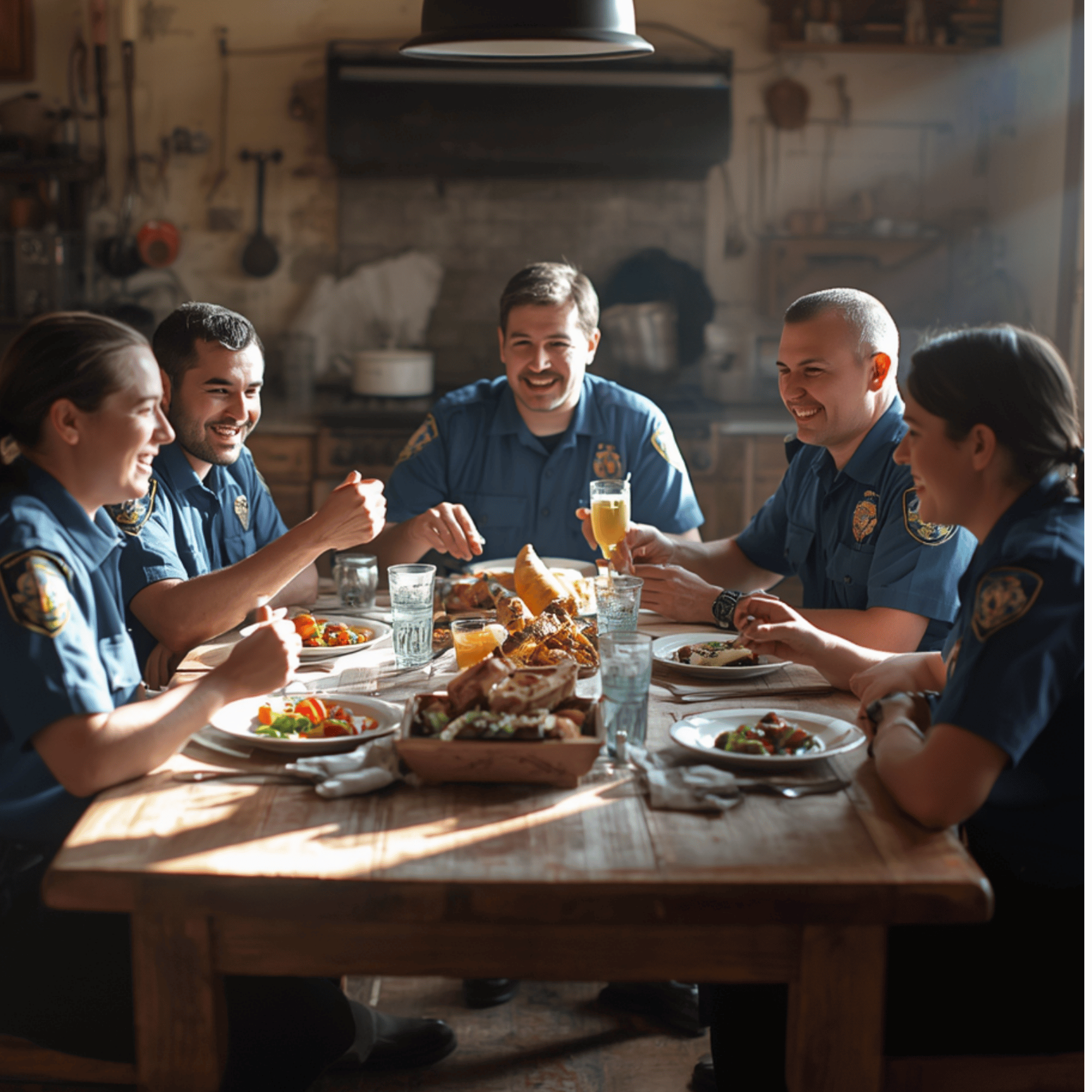
And here's your tailboard talk question for the crew: What physical ability should every firefighter maintain throughout their career, and how should we measure it? Have that [00:11:00] conversation around the kitchen table. Keep it focused on readiness and improvement. Don't turn it into a discussion about someone's appearance, age, or body size.
The purpose is to help each other become more capable, not to embarrass anyone. And now it's time for some questionable humor. Apparently, round is a shape. Unfortunately, it isn't one of the fire ground fitness standards. Being healthy enough for the job isn't about looking like a fitness model, it isn't about winning a competition, and it isn't about proving that you are tougher than the person sitting beside you.
It's about being prepared when someone needs you. It's about giving your crew a firefighter they can depend on, and it's about giving your family the healthiest version that you can reasonably provide, and it's about protecting the life waiting for you when your time in the fire service ends. Master the basics, know your numbers, train for the job, and build a body that can carry [00:12:00] you into the next chapter of your life.
Until next time, stay safe, take care of one another, and light your fire within.