The Shoulder Wasn't The Whole Problem

Send us Fan Mail The Shoulder Wasn’t the Whole Problem A shoulder injury sent Travis looking for answers. What he found was a bigger lesson about listening to his body, asking better questions, adapting his approach, and making wellness part of the life he wants to enjoy—not just something he hopes to get around to after the next shift. In this episode of All Clear, Travis shares his experience with frozen shoulders: the frustration of everyday movements becoming difficult, the treatments and...


Key Takeaways
- Frozen shoulder recovery often requires adapting your exercise routine around your actual physical limitations instead of fighting them or chasing an ideal version of yourself.
- First responders must recognize the difference between resilience and neglect, understanding that simply getting through a shift is not the same as being well.
- Effective healthcare is a partnership where you must communicate clearly with professionals when a current treatment plan is not producing expected progress.
- Pairing a wellness habit, such as building a new exercise routine, with something meaningful like working out with your child can make health goals much easier to sustain.
- Online research and personal stories should always serve as tools to ask better questions rather than acting as a substitute for qualified medical guidance.
The Shoulder Wasn’t the Whole Problem
A shoulder injury sent Travis looking for answers. What he found was a bigger lesson about listening to his body, asking better questions, adapting his approach, and making wellness part of the life he wants to enjoy—not just something he hopes to get around to after the next shift.
In this episode of All Clear, Travis shares his experience with frozen shoulders: the frustration of everyday movements becoming difficult, the treatments and approaches he explored, and the gradual progress that came when he began working with his actual limitations instead of fighting them. Along the way, he discovered that a more consistent exercise routine also created meaningful time with his son.
This is not a prescription for treating frozen shoulder. It is an honest conversation about being an active partner in your own health, recognizing when “pushing through” becomes neglect, and taking the next reasonable step.
In This Episode
The injury that resurfaced years later—and how basic everyday tasks became difficult.
The importance of communicating when a treatment plan is not producing the progress you hoped for.
Exploring different approaches while asking questions about cost, evidence, risk, and realistic expectations.
Why an expensive treatment or confident sales pitch should never replace informed decision-making.
Adapting exercise around what your body can currently tolerate instead of chasing an ideal version of yourself.
How a personal health goal unexpectedly became quality time with Travis’s son.
The difference between resilience and neglect—and why getting through a shift is not the same as being well.
Why wellness includes physical fitness, mental fitness, diet, prevention, and a balanced life.
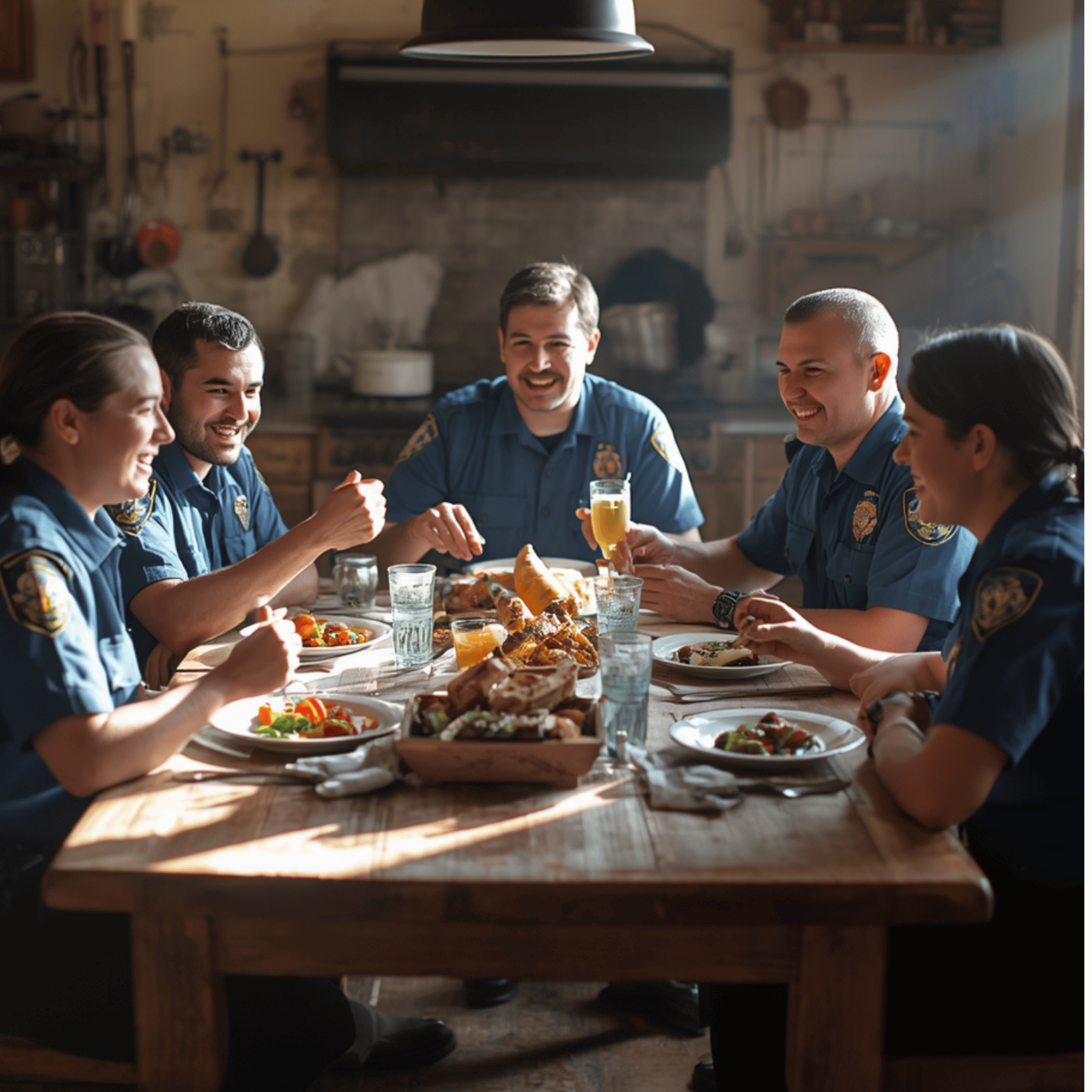
The Kitchen Table Question
Maybe it is a shoulder that no longer moves the way it should, a knee that hurts every morning, sleep that never feels restorative, an appointment you keep postponing, or stress that has become so familiar you barely notice it. The point is not to fix everything at once. It is to stop treating the problem as inevitable and start a useful conversation.
Kitchen Table Actions
Name one health issue you have been working around instead of addressing.
Choose one reasonable next step: schedule an appointment, ask your provider a question, or seek qualified help.
If a current plan is not helping, communicate that clearly with the professional supporting your care.
Look for a form of movement that respects your current abilities and that you can do consistently.
Where possible, connect a wellness habit with something meaningful—such as a walk with your spouse or a workout with your kid.
The All Clear Challenge
The Five Pillars of Wellness
Physical Fitness: Adapt movement to your current ability and build consistency from where you are today.
Mental Fitness: Stay curious, manage frustration, and be willing to reassess when the first approach is not working.
Diet: Recognize nutrition as one part of the wider wellness picture; the episode does not prescribe a specific diet.
Prevention: Pay attention to problems early, seek appropriate care, and ask informed questions.
Balanced Life: Build habits that support work, family, relationships, independence, and the good years ahead.
A Few Important Notes
Travis discusses a range of approaches he personally explored, including physical therapy, trigger point massage, acupuncture, dry needling, stem cell therapy, and peptide compounds BPC-157 and TB-500. He is sharing his experience, not recommending these interventions. He explicitly notes that he cannot establish what caused his improvement, that the compounds are not established treatments for frozen shoulder, and that listeners should not treat online research or personal stories as a substitute for qualified medical guidance.
His reported improvement—roughly 95 percent after more than a year—is his own outcome, not a promise of what another person should expect.
Call to Action
Keep the conversation going. Share this episode with a member of your crew or someone who needs the reminder that taking care of yourself is part of taking care of the people who count on you.
Take care of yourself. Take care of your crew. Keep the conversation going around the kitchen table. Light your fire within.
Thanks for listening to All Clear!
You can contact us with questions, suggestions or just to say hi at our website
allclearpodcast.com
Also pick up a bag of our signature All Clear Coffee. A unique cup that will quickly become your new morning hero in a cup!
Please like and subscribe on you platform of choice! It dosent cost you anything and it helps us more than you will ever know!
Frequently Asked Questions
What is frozen shoulder and how does it impact first responders?
Frozen shoulder involves stiffness and a severe loss of range of motion in the shoulder joint, which can make everyday tasks like getting dressed, putting on a jacket, or donning turnout gear difficult and painful for first responders.
How can I start a successful frozen shoulder recovery plan?
Successful frozen shoulder recovery starts by working with qualified professionals like physical therapists or trainers to find movements you can tolerate and perform consistently, rather than pushing through pain or waiting for the problem to resolve itself.
When should you reconsider a medical treatment plan that isn't working?
If you have consistently followed a prescribed treatment plan for months without meaningful improvement, it is time to communicate that lack of progress clearly to your provider and ask what alternative approaches should be considered.
Why do firefighters struggle with preventative health and injuries?
Firefighters are trained to solve immediate problems and push through discomfort to get the job done, which often leads them to ignore early warning signs, postpone doctor appointments, and normalize chronic pain until it severely impacts their quality of life.
[00:00:00] All clear where the truth cuts through
Welcome to All Clear. I'm Travis, and today I wanna talk about my shoulders. I know, not exactly the most exciting way to start a podcast, but stick with me here because I learned a lot from dealing with frozen shoulders, and what I learned had very little to actually do with my shoulders. It changed how I think about my health, how I approach problems, and how willing I am to consider a different path when the one I'm on isn't working.
Now, if you're a first responder who's spent years pushing through pain and putting everybody else first, you might recognize yourself in this story because I really did You know, years ago, I injured my shoulder during training. I worked through it, recovered, moved on. For years, it wasn't a problem. Then about 12 years later, I was doing some basic yoga when my left shoulder started getting stiff.
There was a dull ache, nothing too bad. It [00:01:00] seemed like it was pretty good initially. So I did what a lot of us do. I pushed through it. Now, the plan-- the pain actually got worse. My range of motion decreased. Eventually, my right shoulder started giving me trouble, too, and then I had no idea why. Suddenly, everyday activities became a challenge.
Putting on a jacket, tucking in my shirt, getting dressed, even putting on and taking off my gear became difficult at work. Now, think about that for a minute. Something you do thousands of times without thinking suddenly requires planning, patience, and a little creativity. And when your job depends on your ability to move, then that becomes more than an inconvenience.
It affects your quality of life. So I did the logical thing. I went to the doctor. Initially, there wasn't a clear explanation. I was given anti-inflammatory medicine and told to give it time. Well, time didn't help. Then I was [00:02:00] referred to an orthopedist. They did imaging, and that didn't reveal any structural damage that explained what I was experiencing.
I was given an even stronger anti-inflammatory medication, but the problem continued. Eventually, I had three options: physical therapy, cortisone injections, or potentially surgery. I hate needles, and surgery wasn't something I wanted to consider unless absolutely necessary. So I chose the logical option, physical therapy.
Now, I followed the prescribed exercises for about two months. I was consistent, I did the work, and I wasn't seeing meaningful improvement. Now, I'm not saying physical therapy doesn't work. I'm not saying doctors were wrong. They were working with the information they had and offering legitimate options.
But I was still hurting, and I needed to understand what else might be going on. Then I started researching, a lot. I spent a lot of time [00:03:00] learning about frozen shoulders, mobility, and the different approaches people use to manage the condition. I consulted that world-famous medical specialist we all know and love, Dr.
Google. Now, before anybody starts diagnosing themselves on the Internet, let me be clear: online research isn't a substitute for a medical professional But learning about my condition helped me ask better questions. I began to understand that this wasn't necessarily something I could fix by stretching harder or simply pushing through the pain.
I needed a different approach, so I started exploring my options. I tried di- dietary changes, chiropractic care, trigger point massage therapy, physical therapy, dry needling, and acupuncture. Now, of those, trigger point massage therapy and acupuncture seemed to provide the most noticeable relief for me. But I still hadn't found a lasting solution.
All of [00:04:00] this was costing time, energy, and money. My health insurance wasn't making the process any easier either. I was frustrated. I wanted my shoulders back. I wanted to get dressed without thinking about it. I wanted to do my job without fighting my own body, and I was getting tired of trying things without knowing whether I was getting anywhere.
That's when I started looking at some options I might not otherwise have considered. Now, one of those was stem cell therapy. I wanted to find out whether it might help. What I encountered was not so great. It involved significant expense, no guarantees, and conversations that sometimes felt more like a sales pitch than medical consultations.
That's how the experience came across to me. Now, I'm not making a blanket statement about stem cell therapy or even, uh, the providers that are offering it. I'm talking about my own experience trying to find a solution. But I had questions about the cost, [00:05:00] evidence, the risk, and whether the potential benefits justified the commitment.
And then there was the possibility of having bone marrow extracted from my pelvis. Yeah, no. I will not be getting any marrow taken from my pelvis, thank you very much. I've got enough going on without adding that to the list Jokes aside, when you're hurting and desperate for answers, it's easy to become vulnerable to the promise of a solution.
You wanna believe the next treatment is going to be the one that fixes everything. But expensive doesn't automatically mean effective. Now, new also doesn't automatically mean better, and a confident sales pitch isn't the same thing as good medical advice. You have to ask questions. You have to understand your risk and make informed decisions.
I still hadn't found the answer I was [00:06:00] looking for. Then another conversation opened up a different avenue. I spoke with a firefighter I knew who was very knowledgeable about bodybuilding supplements and new approaches to recovery. Peptide therapy came up in the conversation, specifically BPC-157 and TB-500.
Now, they were expensive for me, but I was frustrated and willing to consider options I hadn't previously explored. I figured what could it hurt? I pursued that approach and began noticing a little bit of improvement, but I wanted to be careful about what I'm saying here. I can't establish that any of those compounds caused my improvement.
I had tried several interventions, and I was also changing how I approached exercise and rehabilitation. I don't know how much each factor contributed. These compounds also have significant evidence, but they also have safety limitations. They aren't [00:07:00] established treatments for frozen shoulder, and I'm not recommending them to anybody listening.
Do your own research. I'm sharing this because it was part of my experience, not because I believe it's the answer for everyone. Now, here's where the story takes a turn because while I was searching for treatments, I was overlooking something much more practical. I needed to figure out what I could actually do to help myself move better, and a friend of mine helped me get there.
His name is Nathan Medrano. Nathan is a physical trainer, a gym junkie, and generally a pretty healthy dude. He's also very good friends with my family, me, my son, my wife I explained to him what was happening with my shoulders and how much it was affecting my life. His response was simple: "Let's go to the gym.
Let's find some exercises you can do, and let's see what happens." No miracle promise, no complicated theory, just a willingness to work with me [00:08:00] and figure out what I could do. So we started. We adapted exercises to my limitations and focused on movements I could tolerate rather than constantly dwelling on what I couldn't do.
And over the following weeks, I began noticing a difference. My shoulders started to thaw out or start movement. My movements improved. The recovery was gradual, but I was finally making progress. And somewhere along the way, something else happened. I developed a new exercise routine, not one based on what I thought I should be capable of doing, not one designed around some ideal version of myself, but it was one based on where I actually was and what I could consistently do.
Sometimes we're so focused on getting back to where we used to be, we forget to work with where we are today. Think about that. Now, I had to adjust my expectations, find what worked for me, and build [00:09:00] from there. And there was also an unexpected bonus. I found time to work out with my son. What started as an effort to improve my shoulders became an opportunity to spend time together with my son.
We were doing something constructive, building a routine, and sharing time that wasn't about work or everything else competing for our attention. It was just time together. I hadn't started this journey looking for a way to connect with my son. I was just trying to get my shoulders working again. But that became one of the most valuable parts of the experience, and it reminded me that wellness doesn't always have to be another item on an endless to-do list.
Sometimes you can combine things that matter. A workout can become time with your kid. A walk can become an opportunity to reconnect with your spouse. Preparing a meal can become a chance to slow down and spend time with your family. Taking care of yourself doesn't have to mean [00:10:00] separating yourself from the people you love.
Sometimes it can help you show up for them. Now, it's been more than a year now, and my shoulders are roughly ninety-five percent better. I've regained my range of motion, although I still experience some stiffness from time to time. I'm not claiming a perfect recovery, but the difference between where I was and where I am now is significant, and I'm grateful.
I'm grateful for the people who helped me, grateful that I kept asking questions, and grateful for what the experience taught me. You know, I think there's an important distinction here. Getting help doesn't mean handing over every decision and hoping for the best, and taking an active role in your health doesn't mean ignoring medical advice or trying to figure out everything on your own.
I needed medical professionals. I needed information. I needed help. But I also needed to communicate when something wasn't [00:11:00] working, understand my options, and make thoughtful decisions about what to try next. That's a partnership. Your healthcare providers bring their education, experience, and expertise.
You bring your questions, your understanding of what you've been experiencing, and your perspective on how your condition is affecting your daily life. You can respect medical experts and still ask questions. You can follow a treatment plan and speak up when you're not getting improving results. You can seek another opinion when it's appropriate, and you can keep learning without pretending to be an expert yourself.
Now, sometimes the most productive thing you can do is have another conversation and ask, "What else should we consider?" You know, I think this is especially important for those of us in the fire service. You know, we're trained to solve problems. Something goes wrong, we assess the situation, identify the problem, use our resources that are available, and we [00:12:00] take action.
But when it comes to our own health, we don't always apply that same mindset. We ignore the aches. We postpone the appointments. We tell ourselves we'll deal with things after the next shift, and the next big project or the next big responsibility. We get used to working around our limitations, and because we're still getting the job done, we convince ourselves everything must be fine and dandy.
But being able to finish a shift doesn't necessarily mean you're healthy. Being able to push through pain doesn't mean pushing through is always the right answer or the right thing to do. There's a difference between resilience and neglect. Resilience means adapting, seeking help when you need it, and finding a way forward.
Neglect means repeatedly ignoring a problem because dealing with it is inconvenient Sometimes we're so good at pushing through that we actually forget to ask whether we should. [00:13:00] My shoulders forced me to reconsider that approach. I couldn't keep doing what I'd always done and expect a different result.
I had to pay attention, learn, and adapt, and I think the lesson applies to far more than just an injury. At All Clear, we always talk about wellness as something bigger than a single intervention. It's bigger than cancer prevention. It's bigger than a workout program. It's bigger than a supplement or a medication.
Our physical health matters. Nutrition matters. Mental fitness matters. Preventative care matters, and the way we balance our responsibilities, relationships, and personal lives matter. These things actually overlap, and sometimes improving one area creates opportunities in another. In my case, I started with a physical problem, but working through that problem helped me build a more consistent exercise routine and spend more time with my son.
It [00:14:00] reminded me that wellness isn't simply about getting my body to function better. It's about being able to participate more fully in my life. I want to do my job. I want to enjoy my family. I want to maintain my independence, and when retirement eventually comes, I want to enjoy the life I've spent so many years working to build.
I don't just want more years on the calendar. I want more good years. I want mobility, quality of life, the ability to do things that matter to me. We can't prevent every injury or even control every health outcome, but we can pay attention, seek appropriate care, and make decisions that give us the best opportunity to enjoy the years ahead, and that starts before retirement.
Let me say that again. It starts before retirement. It starts with how we take care of ourselves today. So let me ask you [00:15:00] something. What part of your health have you quietly learned to work around? Maybe it's a shoulder that doesn't move quite right. Maybe it's that knee that hurts every morning. Maybe you've been putting off an appointment with your doctor.
Maybe your sleep is terrible, but you've convinced yourself that's just part of life. Or maybe you've been running on stress for so long that you don't recognize how much it's actually affecting you. Whatever it is, ask yourself one question: What is the next reasonable step I can take? Not what will I do when work slows down.
Not what will I do when I have more time. What can I do right now? Maybe it's making an appointment with the doctor. Maybe it's asking your healthcare provider questions you've been avoiding. Maybe it's finding a qualified professional to help you develop an appropriate exercise routine. Maybe it's having an honest conversation with someone you [00:16:00] trust.
You don't have to fix everything tomorrow, but you don't have to accept that things will never improve either. Take one step, then build from there. I started this journey because my shoulders weren't working the way they should. I tried different treatments. I spent a lot of money. I got frustrated. I searched for answers.
Some things seemed to help. Others didn't provide the improvement I wanted. I had to learn to evaluate my options, recognize the limits of what I knew, and stay open to different approaches. Along the way, I built another habit and found that that also provided more time with my son. That's what I want people to take away from this story.
You don't have to become an expert in your health. You don't have to chase every new treatment, and you don't have to do everything yourself. But don't be afraid to [00:17:00] ask questions, seek help, and reconsider your approach when something isn't working. Because the goal isn't simply to survive another shift, it isn't just to finish another year, and it isn't just to make it to retirement.
The goal is to build a life you can enjoy when you get there, a life where you can move, participate, connect, and be present for the people who matter You know, so here's my challenge to you. Take a few minutes this week and think about one thing regarding your health that you've been putting off, something you've been ignoring, or something you've simply learned to live with.
Don't beat yourself up about it. Just be honest. Then figure out your next step. Make that appointment. Ask the questions. Start the conversation. Find the right person to help you. Most importantly, take that step, because your wellness isn't just about you. It's about the people who count on you and [00:18:00] the people waiting for you at home, and the person you want to be when you finally have time to enjoy the life you've worked so hard to build.
I'm Travis. This is All Clear. Be sure to take care of yourself, take care of each other, and remember, looking after the person behind the uniform is also part of the job, too. I'll see you next time, and as we always say on All Clear, light your fire within